Thursday, June 5, 2008

The Girl Who Stopped Swimming


1. Art, and what constitutes true art, is one of the earliest questions raised in THE GIRL WHO STOPPED SWIMMING. Thalia clearly dismisses Laurel's quilts as handicraft, not art. What, in your opinion, is "true art?" Is there such a thing?
2. Laurel's mother brings canned goods and toys to DeLop, but she has severed all emotional connections. Does this disconnect compromise her good works? Do you think a person's motives and feelings make a difference to how valuable a "charitable act" is? Why or Why not?
3. On p. 65, Thalia explains "Mother is Cowslip." Do you know anyone who is prone to "cowslipping?" Can you think of situations where you yourself have cowslipped?
4. The tension between what is on the surface and what lies beneath is dominant in this book. Can you think of some examples of this dichotomy in the text? What statement do you think the author is trying to make by highlighting these dichotomies?
5. The title clearly refers to the discovery of Molly Dufresne in the first chapter of the book. But is there another interpretation you could offer?
6. Thalia consistently needles, pushes, or blasts Laurel out of her comfort zone, usually for what she considers to be Laurel's own good. Do you have a "Thalia" in your life?
7. One particular bone of contention for Laurel and Thalia is Shelby-Thalia clearly believes Laurel is doing her great harm by overprotecting her and keeping her "safe" at home. How do you feel about Laurel's relationship with her daughter-is it as close as Laurel believes, or as false as Thalia insists? Did your view change throughout the book as events unfolded?
8. Laurel and Thalia do not understand each other' marriages; both would say their marriage is better. Thalia's marriage is certainly untraditional, but it seems to work for her. Do you think Thalia's relationship can be considered a good marriage? Does Laurel have a good marriage at the beginning of the book? In what ways? Has there been significant change in that relationship by the end of the book?
9. Laurel makes decisions using intuition and emotion, David through logic and reason. What does Thalia use to make decisions? Is she closer to David or Laurel, or does she have a system of her own?
10. Laurel is her mother's quietly acknowledged favorite, and Thalia seems to belong to Daddy. Is this a "normal" or healthy family dynamic? How does this divided favoritism shape the sisters? Do you think this causes "sibling rivalry?" Have you seen this dynamic at work in your own family, and do you think it affected the way you interact with your parents or siblings? With your own children?
11. Jackson has said in interviews, "At its heart, this is a book about poverty." Do you agree? If not, what did you think the book was about? Do you think she means only literal poverty? What other kinds of poverty did you notice in the book?
12. Thalia provides a logical explanation for all of Laurel's ghosts, assuming her visions have more to do with psychology and the subconscious than the supernatural.. Do you think there are real ghosts in this book? Do you believe in ghosts, or have there been times in your life when you have been convinced of their presence?

The Devil in the White City

Devil in White City Questions


Burnham


Sketches of Holmes ->

1. In what ways is this nonfiction book like a novel? Is it more satisfying to read fiction or nonfiction?

I find fiction more satisfying because there is a story, a plot, with action that I need to imagine in order to understand and enjoy. With non-fiction I need a visual report of the actual people and places, so with this book I have done a lot of googling for images of the Chicago fair.

2. What have you found out so far about Chicago, the Fair, and the two men: Burnham and Holmes? I have found daguerotypes of photos of the fairgrounds. I also am looking for pictures of the people involved in the building of the fair. This picture is landscape architect Fredrich Olmsted.

In The Devil in the White City, Erik Larson takes readers into a richly complex moment in American history, a moment that would draw together the best and worst of the Gilded Age, the grandeur and triumph of the human imagination, and the poverty, violence, and depravity that surrounded it.

The book's two most powerful figures, the great architect Daniel Burnham and the psychopathic killer, Henry H. Holmes, in many ways embody the opposing forces of the age. Burnham was responsible for building the White City, overcoming a series of crushing professional obstacles and personal tragedies to make the Fair the magical, awe-inspiring event that it was. He brought together some of the greatest architects of the day—Charles McKim, George Post, Richard Hunt, Frederick Law Olmsted, and others—convinced them of the importance of the Fair, and somehow got them to work together to achieve what many considered to be an impossible project in an astonishingly brief amount of time. Simultaneously, in the shadow of the White City, Henry H. Holmes set up his own World's Fair Hotel to take advantage of naive young single women arriving in Chicago from surrounding small towns. Using his mesmerizing charm and an uncanny ability to fend off creditors and police, Holmes bent his victims to his will and committed a series of murders as cold-blooded as any in American history.

But The Devil in the White City is about more than just two men. It is about America on the threshold of the twentieth century—a time of widespread violence, fantastic wealth, growing labor unrest, and financial panic; a time when Buffalo Bill could take a bow to Susan B. Anthony; and a time when men and women as diverse as Jane Addams, Theodore Dreiser, Thomas Edison, Samuel Gompers, and Frank Lloyd Wright—could all gaze in wonder at the magnificence of the White City.

top of the page


rgg_discuss.gif (1294 bytes)


1. In the note "Evils Imminent," Erik Larson writes "Beneath the gore and smoke and loam, this book is about the evanescence of life, and why some men choose to fill their brief allotment of time engaging the impossible, others in the manufacture of sorrow" [xi]. What does the book reveal about "the ineluctable conflict between good and evil"? What is the essential difference between men like Daniel Burnham and Henry H. Holmes? Are they alike in any way? They are alike in that in their singlemindness of purpose they go to any lengths to get the job done. Daniel Burnham is not insane. H. H. Holmes is a psychopath.

2. At the end of The Devil in the White City, in Notes and Sources, Larson writes "The thing that entranced me about Chicago in the Gilded Age was the city's willingness to take on the impossible in the name of civic honor, a concept so removed from the modern psyche that two wise readers of early drafts of this book wondered why Chicago was so avid to win the world's fair in the first place" [p. 393]. What motives, in addition to "civic honor," drove Chicago to build the Fair? In what ways might the desire to "out-Eiffel Eiffel" and to show New York that Chicago was more than a meat-packing backwater be seen as problematic? I think that creating jobs must have been an underlying goal of having the World's Fair in Chicago.

3. The White City is repeatedly referred to as a dream. The young poet Edgar Lee Masters called the Court of Honor "an inexhaustible dream of beauty" [p. 252]; Dora Root wrote "I think I should never willingly cease drifting in that dreamland" [p. 253]; Theodore Dreiser said he had been swept "into a dream from which I did not recover for months" [p. 306]; and columnist Teresa Dean found it "cruel . . . to let us dream and drift through heaven for six months, and then to take it out of our lives" [p. 335]. What accounts for the dreamlike quality of the White City? What are the positive and negative aspects of this dream? It was new and white and clean and huge and magnificant.

4. In what ways does the Chicago World's Fair of 1893 change America? What lasting inventions and ideas did it introduce into American culture? What important figures were critically influenced by the Fair?

5. At the end of the book, Larson suggests that "Exactly what motivated Holmes may never be known" [p. 395]. What possible motives are exposed in The Devil in the White City? Why is it important to try to understand the motives of a person like Holmes?

6. After the Fair ended, Ray Stannard Baker noted "What a human downfall after the magnificence and prodigality of the World's Fair which has so recently closed its doors! Heights of splendor, pride, exaltation in one month: depths of wretchedness, suffering, hunger, cold, in the next" [p. 334]. What is the relationship between the opulence and grandeur of the Fair and the poverty and degradation that surrounded it? In what ways does the Fair bring into focus the extreme contrasts of the Gilded Age? What narrative techniques does Larson use to create suspense in the book? How does he end sections and chapters of the book in a manner that makes' the reader anxious to find out what happens next?

7. Larson writes, "The juxtaposition of pride and unfathomed evil struck me as offering powerful insights into the nature of men and their ambitions" [p. 393]. What such insights does the book offer? What more recent stories of pride, ambition, and evil parallel those described in The Devil in the White City?

8. What does The Devil in the White City add to our knowledge about Frederick Law Olmsted and Daniel Burnham? What are the most admirable traits of these two men? What are their most important aesthetic principles?

9. In his speech before his wheel took on its first passengers, George Ferris "happily assured the audience that the man condemned for having ‘wheels in his head' had gotten them out of his head and into the heart of the Midway Plaisance" [p. 279]. In what way is the entire Fair an example of the power of human ingenuity, of the ability to realize the dreams of imagination?

10. How was Holmes able to exert such power over his victims? What weaknesses did he prey upon? Why wasn't he caught earlier? In what ways does his story "illustrate the end of the century" [p. 370] as the Chicago Times-Herald wrote?

11. What satisfaction can be derived from a nonfiction book like The Devil in the White City that cannot be found in novels? In what ways is the book like a novel?

12. In describing the collapse of the roof of Manufacturers and Liberal Arts Building, Larson writes "In a great blur of snow and silvery glass the building's roof—that marvel of late nineteenth-century hubris, enclosing the greatest volume of unobstructed space in history—collapsed to the floor below" [p. 196–97]. Was the entire Fair, in its extravagant size and cost, an exhibition of arrogance? Do such creative acts automatically engender a darker, destructive parallel? Can Holmes be seen as the natural darker side of the Fair's glory?

13. What is the total picture of late nineteenth-century America that emerges from The Devil in the White City? How is that time both like and unlike contemporary America? What are the most significant differences? In what ways does that time mirror the present?


What am I reading now?

East of Eden (about 2/3 through)
The Devil in the White City (BookBuddies)
The Girl Who Stopped Swimming (cori)
The Boy in the Striped Pajamas (GrammaMary)

On hold - have read part of the book but have taken a break:
Barack Obama's book
A Thousand Splendid Suns
Charlatan
Uncle Tom's Cabin

What is next?
Warlock
Lisey's Story

Wednesday, May 21, 2008

East of Eden http://www.steinbeck.org/


This will be the September book at Reading Group Guides.

East of Eden, John Steinbeck's passionate and exhilarating epic, re-creates the seminal stories of Genesis through the intertwined lives of two American families. The result is a purely American saga set in Steinbeck's own childhood home, the Salinas Valley of northern California. The valley is a new world both idyllic and harsh, and Steinbeck sings to it with a personal nostalgia that is clouded by the knowledge that this valley-as all human dwellings-is the location for as much tragedy as triumph.

The first family whose story is told in this novel is the Hamiltons, led by the charismatic poet-patriarch Samuel Hamilton, an Irish immigrant who raises a large and boisterous family on a mean and unyielding plot of land through charm, ingenuity, and adaptability. The Hamiltons are penniless, but Samuel and Liza's strong and traditional marriage yields nine children of every type and talent who brim with affection and potential. The children act out the numerous possibilities of American life, some making money in business and advertising, some seeking love and home life, others failing utterly in their struggle to find meaning and clarity in the chaotic possibility of a new century.

The second family, the Trasks, is introduced to us as a Connecticut father-a false war hero with a fortune of mysterious origin-his used-up wives, and his two sons: the murderous Charles and the sensitive, searching Adam. After a stint in the army and aimless years as a hobo, Adam falls in love and migrates to Salinas, intending to create his own Garden of Eden. There he presides over a fractured home, raising twin sons Caleb and Aron alone after the dissolution of his marriage to the unfathomable, treacherous Catherine Ames. Catherine herself-later known as Kate-represents the potential for evil in the world. Her life in the valley is the antithesis of that which the Trasks and Hamiltons seek to achieve, as she sinks into a limited life of meanness.

The Trasks are what Steinbeck called his "symbol people," and their story reenacts the saga of Cain and Abel, for Steinbeck one of the world's greatest stories of love, rejection, jealousy, and redemption. But Adam and his sons are held together as a family by the Chinese-American philosopher-servant Lee, who offers wisdom in the face of painful circumstances. Together the characters try to formulate personal paradises that can withstand the inevitable challenges of human existence, battling the contradiction between the desire to submit to God and tradition and the human need for self-realization and fulfillment. Much as the United States itself had to resolve its roots in Europe as it absorbed the labor of immigrants from around the world in the creation of a new nation, East of Eden's path-breaking Americans seek to free themselves from the chains of the past and achieve personal freedom.

A brilliant novel of ideas, East of Eden is far-reaching in its effort to explicate the most fundamental trials of mankind. Brutally realistic-and sometimes fatalistic-about people's ability to harm themselves and those around them, it is also a celebration of perseverance, enduring love, and the noble yearning to better oneself. And it is a work of profound optimism about the capacity of humans to triumph over adversity and determine their own fates. In prose both evanescent and dignified, Steinbeck creates in these characters and for the reader "a new love for that glittering instrument, the human soul. It is a lovely and unique thing in the universe. It is always attacked and never destroyed."

top of the page


rgg_discuss.gif (1294 bytes)


1. Steinbeck has a character refer to Americans as a "breed," and near the end of the book Lee says to a conflicted Cal that "We are all descended from the restless, the nervous, the criminals, the arguers and brawlers, but also the brave and independent and generous. If our ancestors had not been that, they would have stayed in their home plots in the other world and starved over the squeezed-out soil." What makes this a quintessentially American book? Can you identify archetypically American qualities-perhaps some of those listed above-in the characters?

2. Sam Hamilton-called a "shining man"-and his children are an immigrant family in the classic American model. What comes with Sam and his wife Liza from the "old country"? How does living in America change them and their children? What opportunities does America provide for the clan, and what challenges?

3. Adam Trask struggles to overcome the actions of others-his father, brother, and wife-and make his own life. What is the lesson that he learns that frees him from Kate and allows him to love his sons? He says to Cal near the end that "if you want to give me a present-give me a good life. That would be something I could value." Does Adam have a good life? What hinders him? Would you characterize his life as successful in the end?

4. Lee is one of the most remarkable characters in American literature, a philosopher trapped by the racial expectations of his time. He is the essence of compassion, erudition, and calm, serving the Trasks while retaining a complex interior and emotional life. Do you understand why he speaks in pidgin, as he explains it to Sam Hamilton? How does his character change-in dress, speech, and action-over the course of the book? And why do you think Lee stays with the Trasks, instead of living on his own in San Francisco and pursuing his dream?

5. Women in the novel are not always as fully realized as the main male characters. The great exception is Adam Trask's wife, Cathy, later Kate the brothel owner. Clearly Kate's evil is meant to be of biblical proportions. Can you understand what motivates her? Is she truly evil or does Steinbeck allow some traces of humanity in his characterization of her? What does her final act, for Aron Trask, indicate about her (well-hidden) emotions?

6. Sibling rivalry is a crushing reoccurrence in East of Eden. First Adam and his brother Charles, then Adam's sons Cal and Aron, act out a drama of jealousy and competition that seems fated: Lee calls the story of Cain and Abel the "symbol story of the human soul." Why do you think this is so, or do you disagree? Have you ever experienced or witnessed such a rivalry? Do all of the siblings in the book act out this drama or do some escape it? If so, how? If all of the "C" characters seem initially to embody evil and all the "A" characters good-in this novel that charts the course of good and evil in human experience-is it true that good and evil are truly separate? Are the C characters also good, the A characters capable of evil?

7. Abra, at first simply an object of sexual competition to Cal and Aron, becomes a more complex character in her relationships with the brothers but also with Lee and her own family. She rebels against Aron's insistence that she be a one-dimensional symbol of pure femininity. What is it that she's really looking for? Compare her to some of the other women in the book (Kate, Liza, Adam's stepmother) and try to identify some of the qualities that set her apart. Do you think she might embody the kind of "modern" woman that emerged in postwar America?

8. Some of Steinbeck's ethnic and racial characterizations are loaded with stereotype. Yet he also makes extremely prescient comments about the role that many races played in the building of America, and he takes the time to give dignity to all types of persons. Lee is one example of a character that constantly subverts expectations. Can you think of other scenes or characters that might have challenged conventional notions in Steinbeck's time? In ours? How unusual do you think it might have been to write about America as a multicultural haven in the 1950s? And do you agree that that is what Steinbeck does, or do you think he reveals a darker side to American diversity?

9. What constitutes true wealth in the book? The Hamiltons and the Trasks are most explicitly differentiated by their relationship to money: though Sam Hamilton works hard he accumulates little, while Adam Trask moons and mourns and lives off the money acquired by his father. Think of different times that money is sought after or rejected by characters (such as Will Hamilton and Cal Trask) and the role that it plays to help and hinder them in realizing their dreams. Does the quest for money ever obscure deeper desires?

10. During the naming of the twins, Lee, Sam, and Adam have a long conversation about a sentence from Genesis, disagreeing over whether God has said an act is ordered or predetermined. Lee continues to think about this conversation and enlists the help of a group of Chinese philosophers to come to a conclusion: that God has given humans choice by saying that they may (the Hebrew word for "may," timshel, becomes a key trope in the novel), that people can choose for themselves. What is Steinbeck trying to say about guilt and forgiveness? About family inheritance versus free will? Think of instances where this distinction is important in the novel, and in your own life.

11. The end of the novel and the future of the Trasks seems to rest with Cal, the son least liked and least understood by his father and the town. What does Cal come to understand about his relationship to his past and to each member of his family? The last scene between Adam and Cal is momentous; what exactly happens between them, and how hopeful a note is this profound ending? Why is Lee trying to force Cal to overturn the assumption that lives are "all inherited"? What do you think Cal's future will be?

12. East of Eden is a combination novel/memoir; Steinbeck writes himself in as a minor character in the book, a member of the Hamilton family. What do you think he gained by morphing genres in this fashion? What distinguishes this from a typical autobiography? What do you think Steinbeck's extremely personal relationship to the material contributes to the novel?

Sunday, May 11, 2008

Water for Elephants


June book for Reading Group Guides.

Just started. It is an old man remembering his life from the age of 93 in a nursing home. The author must have spent time in the nursing home with a relative cause she really got it right. Also the old man mourns the loss of his mother and father in a car accident and this is written perfectly. I love it when books get the emotions just right.


Posted Jun 6, 8:39 AM Hide Post
I have to comment on the ending. If taken literally as what actually happened to Jacob - he ran away and joined the circus - the ending for me is weak and totally out of character with such a realistic style of the story. It becomes a "he lived happily ever after" story. Life for me does not work that way.

However if the subtle writing style of the author is followed carefully throughout the book, I think we have plenty of evidence that Jacob left the nursing home through his dementia and went to a place that he loved - the circus.

My mother did the same thing. The nursing home became a 'school' for her. She had spent her entire life as a teacher. The hallways of the home were the school hallways, the other wing was 'upstairs', the nurses were other teachers, the aides were the 'kids', the dining room was the cafeteria, and the administrator was the 'principal'. She was invited occasionally to help out in the principal's office where she folded letters and stuffed envelopes. This helped her cope with being in the nursing home.

Unfortunately, I don't have the book so that I can cite all of the author's hints, but I can remember a few that clue me in to the dementia that was rapidly progressing for Jacob.

His personality change: He wouldn't sit at his assigned table; he wanted to sit alone; he got so furious at the other old man and so jealous when that old man got the attention of his women friends. That change from a gentle caring fellow to an old geezer indicates brain disfunction.

The fact that he did not have his walker with him when he was taken to the window to watch the circus set up. The author made a point of telling us that this was not the usual way that Jacob was used to. I don't think there is any mention of Jacob having his walker with him as he waited for his family at in the foyer. So he could not have walked to the circus. I don't think he was physically able to go that far anyway.

I think when the family did not come to take him to the circus, and when he learned that Rosemary was leaving, he broke with reality and ran away to the circus in his mind, where he lived the rest of his days. I think the circus man who took him was the replacement for Rosemary. He was a person who was well trained for eldercare and listened to Jacob and valued their conversations. So actually Jacob was able to 'live happily ever after' in his dementia.

Here is a review:

Though he may not speak of them, the memories still dwell inside Jacob Jankowski's ninety-something-year-old mind. Memories of himself as a young man, tossed by fate onto a rickety train that was home to the Benzini Brothers Most Spectacular Show on Earth. Memories of a world filled with freaks and clowns, with wonder and pain and anger and passion; a world with its own narrow, irrational rules, its own way of life, and its own way of death. The world of the circus: to Jacob it was both salvation and a living hell.

Jacob was there because his luck had run out --- orphaned and penniless, he had no direction until he landed on this locomotive "ship of fools." It was the early part of the Great Depression, and everyone in this third-rate circus was lucky to have any job at all. Marlena, the star of the equestrian act, was there because she fell in love with the wrong man, a handsome circus boss with a wide mean streak. And Rosie the elephant was there because she was the great gray hope, the new act that was going to be the salvation of the circus; the only problem was, Rosie didn't have an act --- in fact, she couldn't even follow instructions. The bond that grew among this unlikely trio was one of love and trust, and ultimately, it was their only hope for survival.

Surprising, poignant, and funny, Water for Elephants is that rare novel with a story so engrossing, one is reluctant to put it down; with characters so engaging, they continue to live long after the last page has been turned; with a world built of wonder, a world so real, one starts to breathe its air.

top of the page


rgg_discuss.gif (1294 bytes)


1. To what extent do the chapters concerning the elderly Jacob enhance the chapters recounting the young Jacob's experiences with the Benzini Brothers circus? In what ways do the chapters about the young Jacob contribute to a deeper understanding of the elderly Jacob's life?Here is a passage that tells us so much about Jacob's character: "It's impossible to describe how tenderly I suddenly frrl toward them -- hyenas, camels, and all. Even the polar bear, who sits on his backside chewing his four-inch claws with he four-inch teeth. A love for these animals wells up in me suddenly, a flash flood, and there it is, solid as an obelisk and viscous as water. My father felt it his duty to continue to treat animals long after he stopped getting paid. He couldn't stand by and watch a horse colic or a cow labor with a breech calf even though it meant personal ruin. The parallel is undeniable.......what my father would want me to do -- is look after them, and I am filled with that absolute and unwavering conviction.....I cannot leave these animals. I am their shepherd, their protector. And it's more than a duty. It's a covenant with my father."

2. How does the novel's epigraph, the quote from Dr. Seuss's Horton Hatches the Egg, apply to the novel? What are the roles and importance of faithfulness and loyalty in Water for Elephants? In what ways does Gruen contrast the antagonisms and cruelties of circus life with the equally impressive loyalties and instances of caring?

3. Who did you, upon reading the prologue, think murdered August? What effect did that opening scene of chaos and murder have on your reception of the story that follows?

4. In connection with Jacob's formal dinner with August and Marlena in their stateroom, Jacob remarks, "August is gracious, charming, and mischievous" (page 93). To what extent is this an adequate characterization of August? How would you expand upon Jacob's observation? How would you characterize August? Which situations in the novel reveal his true character?

5. August says of Marlena, "Not everyone can work with liberty horses. It's a God-given talent, a sixth sense, if you will" (page 94). Both August and Jacob recognize Marlena's skills, her "sixth sense," in working with the horses. In what ways does that sixth sense attract each man? How do August and Jacob differ in terms of the importance each places on Marlena's abilities?

6. After Jacob puts Silver Star down, August talks with him about the reality of the circus. "The whole thing's illusion, Jacob," he says, "and there's nothing wrong with that. It's what people want from us. It's what they expect" (page 104). How does Gruen contrast the worlds of reality and illusion in the novel? Is there anything wrong with pandering to people's need for illusion? Why do we crave the illusions that the circus represents?

7. Reflecting on the fact that his platitudes and stories don't hold his children's interest, the elderly Jacob notes, "My real stories are all out of date. So what if I can speak firsthand about the Spanish flu, the advent of the automobile, world wars, cold wars, guerrilla wars, and Sputnik --- that's all ancient history now. But what else do I have to offer?" (page 110). How might we learn to appreciate the stories and life lessons of our elders and encourage people younger than ourselves to appreciate our own?

8. Looking at himself in the mirror, the old Jacob tries "to see beyond the sagging flesh." But he claims, "It's no good. . . . I can't find myself anymore. When did I stop being me?" (page 111). How would you answer that question for Jacob or any individual, or for yourself?

Let's see .....illusions....subtle changes in personality

Jacob is 90 or is he 93?

He won't sit at his regular table.

He is so angry with the other old man who says he carried water for elephants.

He won't cooperate with the nurses.

He says that he knows how important it is to make sure that everyone knows that you have all your marbles.

Ornery...senile??


9. In what ways and to what degree do Uncle Al's maneuvers and practices regarding the defunct Fox Brothers circus reflect traditional American business practices? How would you compare his behavior with that of major businessmen and financiers of today? What alternative actions would you prefer? p.146 "There is no question that I am the only thing standing between these animals and the business practices of August and Uncle Al, and what my father would do..."

10. As he lies on his bedroll, after his night with Barbara and Nell, Jacob cannot empty his mind of troubling visions and he reflects that "the more distressing the memory, the more persistent its presence" (page 143). How might the elderly Jacob's memories corroborate or contradict this observation? What have been your experiences and observations in this regard?

11. In his Carnival of the Animals, Ogden Nash wrote, "Elephants are useful friends." In what ways is Rosie a "useful" friend? What is Rosie's role in the events that follow her acquisition by Uncle Al?

12. After Jacob successfully coaches August in Polish commands for Rosie, he observes, "It's only when I catch Rosie actually purring under August's loving ministrations that my conviction starts to crumble. And what I'm left looking at in its place is a terrible thing" (page 229). What is Jacob left "looking at," how does it pertain to August's personality and Jacob's relationship with August, and what makes it a "terrible thing"?

13. How did you react to the redlighting of Walter and Camel, and eight others, off the trestle? How might we see Uncle Al's cutthroat behavior as "an indictment of a lifetime spent feigning emotions to make a buck" (in the words of one reviewer)?

14. After the collapse of the Benzini Brothers circus and Uncle Al's having "done a runner" (page 314), Jacob realizes, "Not only am I unemployed and homeless, but I also have a pregnant woman, bereaved dog, elephant, and eleven horses to take care of" (page 317). What expectations did you entertain for Jacob and Marlena's --- and their menagerie's --- future after they leave the Benzini Brothers circus? How do the elderly Jacob's memories of Marlena and their life together confirm or alter those expectations?

15. At the end of the novel, Jacob exclaims, "So what if I'm ninety-three? . . . why the hell shouldn't I run away with the circus?" (page 331). What would you project to be the elderly Jacob's experiences after he runs away with the circus the second time? How does his decision reflect what we have learned about his early years?

I think that the final scenes happened only in Jacob's mind. He spent the rest of his days, months, years in the circus, away from the reality of the nursing home. He had a break with reality earlier and then when his family did not come to take him to the circus, and he found out that he was loosing his nurse, Rosemary, he ran away to the circus in his mind. My best evidence of this is that he did not take his walker to the waiting room with him. He went in his wheel chair only. Remember the tension that he caused because a nurse would not get him his walker earlier. In the waiting room scene, there was no mention of the walker until he leaves.

I spent 8 years with my mother in a wonderful nursing home, and I know how she escaped....


16. Sara Gruen has said that the "backbone" of her novel "parallels the biblical story of Jacob," in the book of Genesis. On the first night after his leaving Cornell, for example, Jacob --- as did his biblical namesake --- lies "back on the bank, resting my head on a flat stone" (page 23). In what other ways does Water for Elephants parallel the story of the biblical Jacob? How do the names of many of the characters reflect names of characters in the biblical account?

17. In the words of one reviewer, Water for Elephants "explores . . . the pathetic grandeur of the Depression-era circus." In what ways and to what extent do the words "pathetic grandeur" describe the world that Gruen creates in her novel? I think so much of the Depression era is pathetic. No one has work and those who work for the circus don't get paid, but at least they have a warm place to sleep and food to eat. Their treatment of each other is pathetic at times with the redlighting and segregation of different workers and the drinking and even the horror that mentally ill people and old folks are not taken care of. The grandeur is the spectacle and illusion of the circus! Escapism at its best.

These book-group discussion questions were prepared by Hal Hager, of Hal Hager & Associates, Somerville, New Jersey.


Monday, April 21, 2008

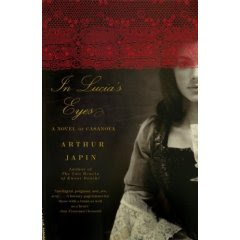
In Lucia's Eyes - comments from BookBuddies and Reading Group Guides

Amsterdam 1758, and a man is artfully seducing a woman. He is, to all appearances, Monsieur le Chevalier de Seingalt, a French government envoy selling shares to the Dutch; she is a courtesan, wellknown in Amsterdam for the fact that she never removes her veil. He sets her a challenge: if she can find a woman who has suffered after falling in love with him, she is entitled to resist his charms; if not, she should succumb. What Seingalt doesn't know is that he has already met the veiled woman many years ago, in another life. What Lucia doesn’t know is that Seingalt will go down in history as one of
the world’s greatest lovers, Casanova. The inspiration for this perfectly plotted, wonderfully romantic historical novel lies in Casanova’s memoirs, and a tiny reference to the woman he fell in love with at seventeen, but later met, hideously disfigured, in an Amsterdam brothel. Arthur Japin has expanded this anecdote into a deliciously entertaining and moving story of innocence and experience, love and sacrifice - all seen through eyes of the woman who first broke Casanova’s heart. His cunning narrative takes the reader on an entrancing journey from the canals of Amsterdam to those of Venice, painting a glorious portrait of the eighteenth century with all its contradictions of reason and instinct, wit and sensuality, head and heart. http://www.arthurjapin.nl/boekboek/show/id=72466

The complete review's Review:

In Lucia's Eyes is based on Casanova's life, events briefly mentioned in his memoirs: the Lucia of the title is a girl he knew (and adored) when she was fourteen, and then meets again when she is a disfigured prostitute in Amsterdam less than two decades later, when all that he once saw in her is now lost. Japin imagines her story, and lets her tell it, making of her a different sort of heroine in a clever reimagining of history.
Lucia and young Giacomo fall in an almost innocent sort of love -- Casanova restraining himself (more or less) because of the girl's tender age, and promising to come back for her when he has to leave the almost idyllic estate where she was raised and which he was visiting.. However, in his absence she becomes infected with and horribly disfigured by smallpox, and can't bear the thought of facing him, and she runs away from home. A smart girl, she picks up learning everywhere she goes, but remains tormented by her appearance.
Eventually, she comes to hide behind a veil -- and finds that this actually makes her beguiling again, men curious to know what hides behind it. But the veil isn't just so that she can go around without constantly being stared at. It serves her in other ways too:

I hide the world.
I have lowered a curtain before it.
Through that haze of lace and silk it looks so much softer

As in The Two Hearts of Kwasi Boachi, Japin again brings an outsider to the Netherlands to comment on his homeland. Just as with Kwasi, true acceptance proves much more elusive than tolerance:
It was some time before I realized a thing assumed among the Dutch: Tolerance is not the equal of acceptance. Indeed, the two are more nearly opposites, the former sometimes serving as a subtle means of repression. To accept another is to embrace him unconditionally, now and always. But to tolerate him is to suggest in the same breath that he is rather an inconvenience, like a nagging pain or an unpleasant odor demanding temporary forbearance.
There are other encounters with Casanova, of course, the great lost love of her life. She can't quite come to terms with it, but by the end seems to have reconciled herself to her fate.
Japin invents a convincing voice for Lucia, and the life he imagines for her makes for a compelling and engaging story. Less 'a novel of Casanova' than of an outsider dealing with the near-impossibility of being accepted in a way most take for granted, In Lucia's Eyes is a good historical read. http://www.complete-review.com/reviews/niederld/japina1.htm

In Lucia's Eyes ~ for Feburary discussion at BookBuddies The following was posted by Bonnie Jacobs:
Lucia works as a servant girl in Italy and is engaged to be married. But after the pox disfigures her face, she flees in shame without telling her lover. Years later, as a reknowned Amsterdam courtesan who never goes out without her veil, Lucia is at the theater when she recognizes her long-lost fiancé, Giacomo Casanova; and she cannot resist the opportunity to encounter him again. Based on a woman who appeared briefly in Casanova’s legendary diaries, Lucia emerges as a brilliant woman who becomes every bit his match. In Lucia’s Eyes by Arthur Japin is an elegant and moving story of love denied and transformed.

According to brief references in his autobiography, the adult Casanova happens upon his lost adolescent love, Lucia, in an Amsterdam brothel where he is shocked to find that she has become, in his own words, "repulsive" (see the author’s postscript on page 233). Japin imagines this chance meeting of the former sweethearts through the eyes of the young woman herself, constructing Lucia’s own autobiography almost as a counterpart to Casanova’s celebrated memoirs. In Japin’s hands, the story of Lucia’s tragic life becomes a complex exploration of the meaning of love and human nature, as well as an unflinchingly honest portrait of Dutch prostitution in the eighteenth century.

The beautiful and innocent Lucia falls in love with the dashing young Casanova, whom she meets at her childhood home in rural northern Italy. When Casanova leaves for Venice to pursue his diplomatic career, promising to return in the spring to marry Lucia, tragedy strikes: Lucia becomes ill with smallpox. She survives the ordeal but her face is permanently scarred and ugly. Knowing that Casanova cannot pursue his career in Venice with an unsightly wife, she chooses to give him up — instructing her mother to tell him that in his absence she ran off with a courier. The rejected Casanova departs, and Lucia, in desperation, flees her home forever to make her way alone.

In Bologna, Lucia develops her new identity, Galathée de Pompignac, and becomes a secretary to Zélide, a French female archaeologist. As they travel together through Italy and France, Lucia’s education is furthered by the ideas of the Europe’s nascent Age of Enlightenment. However, after Zélide’s untimely death, Lucia moves on to Amsterdam where it is not long before her destitution drives her to the sordid life of a prostitute. Years later, after Lucia’s position has finally improved and she has become a highly-desired courtesan, Lucia’s emotional foundation is shaken to its core by a chance encounter with the love of her youth: Casanova. The reunion of the former lovers reveals the true meaning of love and survival for Lucia and, ultimately, brings her a chance for a new life.

If you want to know the WHOLE story, you could also read Giacomo Casanova's History of My Life. Known as a womanizer, Casanova retired at 60 to write about his life. Because every previous edition of Casonova's Memoirs had been abridged to suppress the author's political and religious views and tame his vivid, often racy, style, the literary world considered it a major event when Willard R. Trask's translation of the complete original text was published in six double volumes between 1966 and 1971. Trask's award-winning translation now appears in paperback for the first time (at 1512 pages long).

Een Schitterend Gebrek
The original Dutch title of our February book is: Een Schitterend Gebrek.
It means: A Magnificent Handicap. Now my question is: Why is the book titled this way?

Posted by Margreet at 6:56 AM 2 comments
Labels: ILE, ILE-DQ, Margreet
Tuesday, January 22, 2008

Saturday, February 2, 2008
ILE ~ discussion questions ~ Part 1
Here are some DQs for Part 1 ~ The Benefit of Love:

1. How do Lucia’s early relationships shape the person she becomes? What does the Countess of Montereale give Lucia that her own mother cannot?

2. Lucia claims to have faith in self-delusion. She says, "Self-delusion has the benefit of letting us believe that everything is still possible. I have a talent for that" (p. 14). She also says, "Truth is more than the things you see; that is why its value is only relative. I am very careful with it" (p. 16). And she goes so far as to say, "The only thing that can change reality is the mind. ... If one would change things, one needn’t touch them; one need only see them differently" (p. 46). In what ways does Lucia delude herself? When does she choose the truth over self-delusion?

3. Lucia says of men, "Most aim to please with little understanding of our pleasure. ... More than anything, men want that which has been withheld. A happy certainty is no match for a mystery denied. Given a choice, a man will always take the unknown" (pp. 8–10). What is Lucia’s opinion about men?

4. Why did Giacomo change his name to Seingalt?

Part 2 ~ A Great Imperfection (5-8)

5. At what point does Lucia realize that the Chevalier de Seingalt is Casanova? What does he do or say that causes her to realize that the adult Casanova is a different person than the young man whom she loved and who loved her? Why does this realization make her finally enter into the wager he proposes?

6. Lucia states in the beginning of the novel that she is annoyed to be aroused by the figure of Monsieur le Chevalier de Seingalt because she is "the one who arouses desire" [p. 6]. How does this early insight into Lucia’s personality affect the reader’s opinion of her as her story unfolds? Lucia seems to believe that even before her illness she was a "carnal" being, as evidenced by her "satisfaction" with her submission to the Count of Montereale [pp. 99–100]. Does Japin create a sense of inevitability in Lucia’s fate, even before her unfortunate illness?

7. Monsieur de Pompignac taught Lucia that intellectual reasoning and knowledge are paramount. Lucia learned her lessons well. While overcoming smallpox, Lucia concludes: "If my reason could save me from this moment, there was nothing from which it could not deliver me" [p. 93]. However, Zélide tells Lucia, "Reason is but the shell of consciousness, beneath which emotion is far more knowing" [p. 117]. Does Lucia reconcile Zélide’s teachings with those of Monsieur de Pompignac? Is the conflict of reason versus emotion ever reconcilable for her? Which serves Lucia better in her life: reason or emotion?

8. Does the Venice that Lucia visits with Zélide [p. 128] measure up to the image of that city impressed upon her by the Countess of Montereale [pp. 36–38]? Likewise, does the Amsterdam that Lucia inhabits [p. 163] measure up to the image of that city impressed upon her by Monsieur de Pompignac [p. 142]? How does Japin develop his portraits of these two cities through Lucia’s eyes?

Part 3 ~ Theatrum Amatorium (9-19)

9. Toby said, "I haven't finished the book yet, but I had been wondering if when I was younger, if I had hid my face from my old boyfriend, would he had realized it was me? Wouldn't he had recognized my voice? That is what I would ask Lucia & G." Good question. Bonnie wondered, "Wouldn't Giacomo have recognized the voice of his very recent lover when Lucia appeared as a decrepit old woman?" Although Lucia confides what she did, I'm not sure this would be enough to fool him. What do you think?

"I am as happy to see you prosperous," I said in Italian, attempting the higher, softer voice of my youth, "as you must be disturbed at seeing what has become of me."

10. How did Lucia's feelings toward her parents change, and why?

11. What is the significance to Lucia of the story of her feebleminded cousin Geppo (pp. 147-179)? (Bonnie: Although I just finished the book last night, I'm asking, "Who?" I know I read those 32 pages, but ... huh?)

12. Lucia states, "At last, I had stopped imagining myself in the gaze of others. . . . And so the mask I had put on to distance myself actually brought me closer to other people" (p. 198). How does wearing a veil bring Lucia closer to others? How does Lucia’s veil affect others’ perception of her? Does it affect how she perceives herself?

13. Of Amsterdam society Lucia says, "Tolerance is not the equal of acceptance. Indeed, the two are more nearly opposites, the former sometimes serving as a subtle means of repression" (p. 163). In the book, appearances and looks are very focal to the urban societies of eighteenth-century Europe. Is Western society in the twenty-first century any different than Amsterdam with respect to its treatment of scarred or unsightly people? How might contemporary Western society respond to a veiled woman?

14. Lucia says, "I too tried to carry the yoke of reason, but it was too heavy for me. I rejected it" (pp. 230—231). From Lucia’s point of view, the Age of Enlightenment resulted in confusion rather than progress. How does Casanova reflect this confusion? Can Lucia reject the confusion of her age entirely, or has she been shaped by it herself? Has Lucia’s education, her exposure to scholarship and reason in the house of the Morandi Manzolinis (pp. 103–108), benefited her in any way that she is not acknowledging? How might Lucia have fared differently if she had been schooled in religion and faith and never exposed to science and knowledge?

15. How are Lucia’s emotional and physical relations with the adult Casanova different from her relations with other men? What has Giacomo Casanova learned as a seducer of women? Is he more artful than Lucia when it comes to seduction? How does viewing Casanova through Lucia’s eyes alter the reader’s preconceptions of Casanova?

16. After her illness, Lucia deduces that she must abandon Casanova because staying with him would have "produced two unhappy people," whereas leaving him would have produced "only one" (p. 97). After meeting de Seingalt years later, she recalculates with hindsight: "Would the tender Giacomo of Pasiano have ever changed into the cynical Jacques de Seingalt if I had listened to my girlish heart and not subdued my fierce desire with clear-eyed foresight? What if I had dared to show him myself ravaged, trusting to our love, letting life and nature run their course instead of sacrificing myself like some inane operatic heroine? In that case, I alone would have been disfigured; now we both were" (p. 158). With the benefit of hindsight, might Lucia have trusted to their love if she had the chance to do it again? Should she have? How might Lucia’s life have turned out differently if Casanova had rejected her? Is Casanova in fact "disfigured" by Lucia’s youthful rejection of him?

17. Casanova states the lesson of his own life: "It is unpardonable sin not to take what love puts before you" (p. 223). What does Lucia think of this "lesson"? Why does Lucia not view this as her own life’s lesson?

18. After their wager is over, and Galathée removes her veil to become Lucia again for Casanova, she says of her appearance "at that moment it wasn’t a source of shame. ... Suddenly I saw, like some saintly vision, the lesson Fate had been trying to teach me" (p. 217). What did Lucia learn in that moment? Did this revelation make her suffering worthwhile in her view?

19. What in Seingalt’s final letter to Lucia makes her change her mind and leave with Jamieson?


ILE-Discussion Questions Part 2
5. At what point does Lucia realize that the Chevalier de Seingalt is Casanova? What does he do or say that causes her to realize that the adult Casanova is a different person than the young man whom she loved and who loved her? Why does this realization make her finally enter into the wager he proposes?

On page 155 it says, "When did I see my Giacomo in that silken Frenchman? In retrospect I can scarcely believe my recognition was not immediate, the very moment he was brought to my box at the theatre. . .In any case, when his wig blew off in the storm by the Amstel, there was no doubt."
At first, when he expresses his bitterness about women, she begins to see he has changed-"the bitterness born of his first betrayal, the contempt it had engendered for all other women." Also in his telling her of how he was wronged by a woman in the past, he "revealed that in his heart he accounted as some sort of cheap swindle what was my life's great tragedy." I think she always thought of his love being greater than hers, but as she realizes this is not true, she enters the wager to show that she was indeed worse off because of his love for her.

6. Lucia states in the beginning of the novel that she is annoyed to be aroused by the figure of Monsieur le Chevalier de Seingalt because she is "the one who arouses desire" [p. 6]. How does this early insight into Lucia’s personality affect the reader’s opinion of her as her story unfolds? Lucia seems to believe that even before her illness she was a "carnal" being, as evidenced by her "satisfaction" with her submission to the Count of Montereale [pp. 99–100]. Does Japin create a sense of inevitability in Lucia’s fate, even before her unfortunate illness?

I felt more like Japin didn't want to portray her as a victim, even though she experienced many tragedies in her life. She is a very strong woman to have made the decisions she has made.

7. Monsieur de Pompignac taught Lucia that intellectual reasoning and knowledge are paramount. Lucia learned her lessons well. While overcoming smallpox, Lucia concludes: "If my reason could save me from this moment, there was nothing from which it could not deliver me" [p. 93]. However, Zélide tells Lucia, "Reason is but the shell of consciousness, beneath which emotion is far more knowing" [p. 117]. Does Lucia reconcile Zélide’s teachings with those of Monsieur de Pompignac? Is the conflict of reason versus emotion ever reconcilable for her? Which serves Lucia better in her life: reason or emotion?

Okay, I was aware of this conflict between reason and emotion throughout the book, but couldn't quite grasp the final message. The comment from Zelide quoted above for me has a depth that my mind has been too lazy to fathom. In the end Lucia says, "For a long time I too tried to carry the yoke of reason, but it was too heavy for me. I rejected it." It seems that more than one winning over the other, we need both at different times in our lives and for different purposes.

8. Does the Venice that Lucia visits with Zélide [p. 128] measure up to the image of that city impressed upon her by the Countess of Montereale [pp. 36–38]? Likewise, does the Amsterdam that Lucia inhabits [p. 163] measure up to the image of that city impressed upon her by Monsieur de Pompignac [p. 142]? How does Japin develop his portraits of these two cities through Lucia’s eyes?

Lucia says on page 125, "Compared with my fallen dream (the tarnished image she had of Venice after she knows she will never be with Giacomo), the Venice I found with Zelide was far worse: sludge on the bridges, alleys choked with rubbish...", etc. As she mixes a bit with society, she finds it very much the same as the Countess described--when she goes to the theatre and nobody is even watching the show, they are all so absorbed in making their place in society. It confirms her opinion that Giacamo never would have been successful if she had been by his side.
Amsterdam only partially lived up to its reputation of "tolerance". I love this part: "It was some time before I realized a thing assumed among the Dutch: Tolerance is not the equal of acceptance. Indeed, the two are more nearly opposites, the former sometimes serving as subtle means of repression. To accept another is to embrace him unconditionally, now and always. But to tolerate him is to suggest in the same breath that he is rather an inconvenience, like a nagging pain or an unpleasant odor demanding temporary forbearance."

I guess he develops the portraits of the two cities by starting out with what she envisions, and then the comparison with reality, and her eventual adjustment to her world.

Posted by Chain Reader at 1:45 PM 4 comments
Labels: ILE, Shelley
ILE DQ
5. When Seingalt talked about the glass?
6. Both Lucia & G. are afraid of falling in love again. Lucia does what she has to do to survive.
7. Reason. If she followed her heart, she would never let G. go & then there would be no conflict.
8. From what I can remember, Venice was filthy, I think. Anyway, Lucia can only think of G.

Zelide said that she wanted a girlfriend. Okay, we all like to have friends, but when she wanted both of them to get naked, was it because Zelide was gay or just a free thinker? Lucia seemed to indicate that Zelide wanted to see Lucia naked. Then again, maybe Zelide is the type of person that has a big personality, ah outgoing, dramatic...

It's finally getting interesting. G.'s brother recognizes her. Does he believe her when she denies who she is? I was shocked when he ripped up his drawing of her & threw it into the water. OMG!!!! Don't rip up your arwork!!!!! Geesh! Just let her keep it.

Posted by Toby at 1:15 AM 0 comments
Labels: ILE, Toby
Toby's DQ ~ why the name change?
Toby asked, "Why did Giacomo change his name to Seingalt?"

Since I (Bonnie) don't know, I'm hoping the answer comes up in the next section of the book. When it does, somebuddy jump in here and give us the answer. Inquiring minds want to know.

Posted by Bonnie Jacobs at 12:53 AM 0 comments
Labels: Bonnie, ILE, ILE-DQ, Toby
ILE's QUESTIONS Part 1
1) Lucia grows up in an upper class family,the masters, even though her parents are considered lower class, the sevants. Lucia gets a private tutor to educate her. She also has the freedom to mingle with upper class men & encouraged to fall in love with an upper class man. The old lady's doing. That old man creeps me out. He tells Lucia, who's about 15 years old. You are ripe now. I can smell it. He describes the smell & greedily smells the air. Ich!!!!!!! Run Lucia, Run!!!!!
2) She gives up the love of her life because she believes that 1 person being happy is better than both being unhappy. ( I've read alot, so not sure which part this belongs in.)
3) Who knows what Lucia thinks of men! She thinks so much, but she is basically just being honest about her feelings. Maybe she thinks that men like to chase women & then dump them when they catch them.
I found the names too long to remember, & have to ask myself, which guy are they talking about now. It would be easier if they said Bob, Mike or Harry. LOL!

Posted by Toby at 12:23 AM 0 comments
Labels: ILE, Toby
Tuesday, February 5, 2008
ILE-DQ ~ When did she know?
Neco, you wrote:

One thing I thought about as coming to the end of reading this part was when did Lucia know that Seingalt was Giacomo? When she first saw him walking from her boat? At the theater? That night at the house before the storm? Or didn't she know until he told the story of the girl he first loved to her?

Now that's a good DQ! I think she recognized him right away, but she doesn't want to reveal herself, so she keeps quiet, wondering when Giacomo will realize it's her. But I think he doesn't remember her at all, she was just a child to have fun with, and she has gone from his memory long ago. And to think she sacrificed herself for his sake (well, that's what I think after reading part 1). We'll see how it goes.

Posted by Margreet at 1:01 PM 1 comments
Labels: ILE, ILE-DQ, Margreet
PHEW!!
What an immense relief to read your comments, Bonnie, Neco and Shirley. I finished part one last week, and put the book aside to keep to our schedule for a change...And to be honest that wasn't a big sacrifice. I seem to be not so very interested in Lucia and Giacomo. Esp. Giacomo, I find him a narcissist jerk (which he probably was!). To slowly unravel Lucia's story, as told by Japin, is sort of fascinating though.
I couldn't do anything with the discussion questions, I was wondering if they were about the book I am reading,,hahahahahaha.

Lucia's childhood sounds like a happy one, living on a big estate, favoured by the landowner/lady. To crawl into bed with Giacomo with her parents' permission sounded very weird. She ended up as a courtisane, or prostitute. After only having read part one as yet, I don't know why this happened.

I had to laugh when you, Bonnie, wrote that you fell asleep even the first time around. Maybe when we have finished the book we will realize what a great work of literature this is, but now I don't really see it. I find the buildup of the story too 'artistic', if you know what I mean. Sorry folks!

Posted by Margreet at 12:50 PM 0 comments
Labels: ILE, Margreet
Questions on Part 1
Whew! I'm glad that I wasn't alone in not having any insight on the posted questions. I read the book and enjoyed the tale, but unfortunately remember less than I'd like of the details. It was due back to the library otherwise I would have tried to have kept more to the schedule.

Posted by Shirley at 5:50 AM 0 comments
Labels: ILE, Shirley
Part One of ILE
I must admit I was feeling a bit bewildered and waiting to see what someone else would post as their answers before posting. So when Bonnie posted:


Okay, I have finally finished reading Part 1. Now, sigh, I look at the questions in light of what I've read ... and I don't have answers.

I felt less alone in my confusion and more confident in rereading and posting up some sort of answer.

One thing I thought about as coming to the end of reading this part was when did Lucia know that Seingalt was Giacomo? When she first saw him walking from her boat? At the theater? That night at the house before the storm? Or didn't she know until he told the story of the girl he first loved to her?

Okay, going to go reread bits of part one now.


Posted by Neco at 12:40 AM 0 comments
Labels: Anne, ILE, Neco
Monday, February 4, 2008
ILE ~ a look at Part 1
Okay, I have finally finished reading Part 1. (You ask how I could post questions when I hadn't even read the assigned section? Easy. I found questions online and posted only those that referred to pages within Part 1.) Now, sigh, I look at the questions in light of what I've read ... and I don't have answers.

How do Lucia’s early relationships shape the person she becomes?
I don't know. She seemed to live an idyllic life at Pasiano, thinking it belonged to her family, unaware that her parents actually worked for the owner ... and even the owner (the countess) thinking of Lucia like a grandchild. I'm confused. Maybe I'm confused because I need to sort out which scenes in Part 1 happened when Lucia was a child (a 14-year-old "child" who regularly climbed into bed with Giacomo) and which scenes told me about the mature Lucia playing mind games with "Seingalt." Maybe I need to re-read all I've read, marking the passages as "now" and "then"? But, sigh, I kept falling asleep when I tried to read it the FIRST time around. Maybe I'm just not interested enough in how he did/does/will get her into bed ... or not. And somehow that's where this whole story seems to be heading:


In his embrace, I felt the odd union of perfect safety and unrestrained appetite. (p. 66)
What does the Countess of Montereale give Lucia that her own mother cannot?
I don't know ... maybe schooling Lucia to become the wife of a diplomat?

The countess, who had been midwife to the frolic-some birth of our relations, was only too pleased to be god-mother of our future happiness. ... Toward this end, she asked her husband ... to extend Monsieur de Pompignac's appointment. With his work accomplished and Adriana's wedding behind him, the teacher had already packed his bags when he received the happy news that his employment at idyllic Pasiano was to be extended. He seemed quite confident of being able to manage a rather different sort of instruction with his new charge: In the coming autumn and winter, the countess had ordered, he was to school me in the manners of gentlefolk and make of me a wife befitting a diplomat. (p. 67)
Lucia says of men, "Most aim to please with little understanding of our pleasure. ... More than anything, men want that which has been withheld. A happy certainty is no match for a mystery denied. Given a choice, a man will always take the unknown" (pp. 8–10). What is Lucia’s opinion about men?

I definitely get the feeling she doesn't think highly of most (maybe any) of them: "There is nothing a man can say to a woman that I haven't heard before" (p. 8), she thinks. And on the same page: "Some women live for sweet talk. I would rather go without. But how is a man to know that? Most aim to please with little understanding of our pleasure." It was to Seingalt himself that she said, "Give it up, sir ... You have met your match" (p. 10).

Posted by Bonnie Jacobs at 8:02 PM 0 comments

Posted by Bonnie Jacobs at 8:15 PM Thursday, February 14, 2008

Zorro
Posted Apr 24, 10:36 AM
Karin,
What is the attitude in the Netherlands toward prostitutes?
What is the difference between a prostitute and a courtesan?
Is there a different word for 'love' in Dutch that means something different from what these women provide?

The title of Part 1 is 'The Benefit of Love'

Does that 'Love' word mean something different than the love we have for our husbands?

Are you reading in English or in Dutch? How would you rate this translation?

Zorro

Did any of you watch John Adams recently on HBO. You may have noticed the white make-up that the French women wore. The girls Giovanna and Danae were applying makeup before they went out. "I had used Spanish paper to apply a light blush over my protegees white lead cheeks..p. 22

Here is a little information about the lead (that was poisonous)that they applied to their faces.

>>>>>>>>>>>>>>>>>>>>>>>
Women wore white lead and chalk on their faces ....

During the European middle ages, pale skin was a sign of wealth. Sixth century women sought drastic measures to achieve that look by bleeding themselves, although, in contrast, Spanish prostitutes wore pink makeup. Thirteenth century affluent women donned pink lipstick as proof they could afford synthetic makeup.

During the Italian Renaissance, lead pain was used to lighten the face, which was very damaging to the wearer. Aqua Toffana was a popular face powder named for its creator, Signora Toffana. Made from arsenic, Signora Toffana instructed her rich clientele to apply the makeup only when their husbands were around. It's interesting to note that Tofana was executed some six hundred dead husbands later.

Cosmetics were seen as a health threat in Elizabethan England, although women wore egg whites over their faces for a glazed look.

During the reign of Charles II, heavy makeup began to surface as a means to contradict the pallor from being inside due to illness epidemics.

During the French Restoration in the 18th century, red rouge and lipstick were used to give the impression of a healthy, fun-loving spirit.

Eventually, people in other countries became repulsed by excessive makeup and claimed the "painted" French had something to hide.

During the Regency era, the most important item was rouge, which was used by most everyone. At that time, eyebrows were blackened and hair was dyed. To prevent a low hairline, a forehead bandage dipped in vinegar in which cats dung had been steeped was worn. Most of the country dwellers' makeup recipes made use of herbs, flowers, fat, brandy, vegetables, spring water and, of course, crushed strawberries. During this era, white skin signified a life of leisure while skin exposed to the sun indicated a life of outdoor labor. In order to maintain a pale complexion, women wore bonnets, carried parasols, and covered all visible parts of their bodies with whiteners and blemish removers. Unfortunately, more than a few of these remedies were lethal.

The most dangerous beauty aids during this time were white lead and
mercury. They not only eventually ruined the skin but also caused hair loss, stomach problems, the shakes, and could even cause death. Although these dangers became known through the death of courtesan Kitty Fisher, the majority of women continued to use these deadly whiteners.
>>>>>>>>>>>>>>>>>>>>>>>
kvb1
Posted Apr 24, 12:46 PM
Hi Zorro!

Prostitution is somewhat allowed here in the Netherlands. It is against the law but we have something that's called "gedoog beleid". Gedogen means allowing it under strict rules and regulations (beleid means policy). Same as for drugs and other things we Dutch are famous for! Even in the century Casanova and Lucia lived in prostitutes were allowed. Did you never heard of the red light district in Amsterdam (we have one here in Alkmaar too)? It's very famous among tourists. Actually I hate that it is a tourist attraction! Every town, city or country has prostitutes, whore houses or whatever and here they are making a tourist attraction out of it. Just like it doesn't exist in other countries! DUH! And like in every good red light district there is a police station at the corner!

There is no difference between a courtesan or a prostitute work wise except for the fact a courtesan is a higher class prostitute and only works for the rich and upper class. Most courtesans were kept women and had houses and money. They also were invited to dinner parties, theater etc. to keep the men company. They were educated and most of the time they knew something about politics and spoke their languages. More like a Geisha I guess.

"Love" - no, it's exactly the same word. Liefde means Love. I have the Dutch version and the translation is accurate. You can also translate it as The Advantage of Love.

Karin

Zorro
Posted Apr 24, 8:34 PM Hide Post
Would you say that the Boleyn girls were raised to be courtesans? Yes, it seems that their family expected this from them.


kvb1
Posted Apr 25, 2:00
I'm not sure but maybe that is the right word for girls who were raised to marry a king or royalty. In those days it was very common. Families protected their grounds, wealth or inheritance by doing this. It was also common to find protection or finance war. Or just simple greed or whatever reasons they might have. Poor girls. Actually it is not that long ago women were free to choose their own partners. Even now with royalties I'm not so sure it is a free choice.

Zorro
Posted Apr 25, 5:08 AM Hide Post
A courtesan in mid-16th century usage referred to a mistress, especially one associated with wealthy, powerful, or upper-class men who provided luxuries and status in exchange for her companionship. In Renaissance Europe, courtesans played an important role in upper-class society, sometimes taking the place of wives at social functions.[citation needed] As it was customary during this time for royal couples to lead separate lives—commonly marrying simply to preserve bloodlines and to secure political alliances—men would often seek sexual gratification and companionship from a courtesan.
http://en.wikipedia.org/wiki/Courtesan

Ramona
Posted Apr 25, 8:31 AM Hide Post
Zorro, Thanks for the info on courtesan's. Sounds much nicer than the name we give these women nowadays--sounds much like high priced call girls. Ramona

Posted Apr 25, 8:40 AM Hide Post
Karin, I found the info you shared on prostitution & drugs in the Netherlands very interesting. I think most cities & towns have their "red light districts" although it's not advertised openly. Have to share a funny story that I think I may have shared before. When I was a teenager & was waiting for my date to pick me up one evening, the light went out on our front porch. My naive mother could only find a red light bulb to replace it so when my date was late, I wondered what was going on. When he finally came to the house, he told us he had driven by several times before stopping because Mom had a red light burning at the front door! LOL! We laughed about that for years. Ramona

What a great story!

Karin

quote:
Originally posted by Ramona:
Karin, I found the info you shared on prostitution & drugs in the Netherlands very interesting. I think most cities & towns have their "red light districts" although it's not advertised openly. Have to share a funny story that I think I may have shared before. When I was a teenager & was waiting for my date to pick me up one evening, the light went out on our front porch. My naive mother could only find a red light bulb to replace it so when my date was late, I wondered what was going on. When he finally came to the house, he told us he had driven by several times before stopping because Mom had a red light burning at the front door! LOL! We laughed about that for years. Ramona

Morning Karin and Ramona, and anyone else who is reading ILE.

I have been considering the conflict in my mind about the 17 year old Casanova as the seminarian, abbe, priest, who meets Lucia in the country home, Pasiano. And also thinking about her lack of inhibition with him (his fondling, and their time spent in bed). And the apparant approval of her parents. At 14, we have seen other girls in other stories of the same period, as old enough for marriage. However they keep talking about her being too young, too naive, etc. And why is a priest up to all this anyway? What are your thoughts?


Posted Apr 27, 5:41 AM Hide Post
quote:
Originally posted by kvb1:
Hi Zorro!

I think the choice of becoming a priest was a bad one. Bad judgement by himself and/or his parents because apparently his talents lay elsewhere. In those days families, with a lot of sons, always send one of the sons to a monastery to become a priest (especially the oldest son). If you could afford the education it had a lot of status having a son as a priest. And you were almost sure you've earned your place in heaven by doing this. Altho the story doesn't tell I'm sure this was the case with Casanova's family too.

I'm not sure when it comes to Lucia. I just think because she was living and raised in a very sheltered environment and being the girl she was (happy, playful and loving) her parents and especially Casanova thought she was too young. They were looking to her character more than to her age, don't you think?

Karin


Zorro
Posted May 3, 7:41
I am really taken aback by the book! I did not realize that I was to be reading about the life of a whore! What an eye-opener! I probably would not have chosen to read the book if I had known what it was about...

I am not quite finished and I hope I get to something that makes me feel glad I spent the time reading this book. Karin, what is it about the book that caused the author to win the awards and accolades?


Zorro
Posted May 3, 8:43 PM Hide Post
Is a "spin house" a whore house? Is that what the places in the Netherlands are called with the big windows with the girls in the windows where the men walk by and they pick out a prostitute?

Boy those scenes with the crazy woman with syphillus eating away her face and mind were awful! There is just so much in this book that I am just not getting! What is the point of these scenes?

Sunday, April 20, 2008

Atonement


Ian McEwan's symphonic novel of love and war, childhood and class, guilt and forgiveness provides all the satisfaction of a brilliant narrative and the provocation we have come to expect from this master of English prose.

On a hot summer day in 1935, thirteen-year-old Briony Tallis witnesses a moment's flirtation between her older sister, Cecilia, and Robbie Turner, the son of a servant and Cecilia's childhood friend. But Briony's incomplete grasp of adult motives–together with her precocious literary gifts–brings about a crime that will change all their lives. As it follows that crime's repercussions through the chaos and carnage of World War II and into the close of the twentieth century, Atonement engages the reader on every conceivable level, with an ease and authority that mark it as a genuine masterpiece.

1. What sort of social and cultural setting does the Tallis house create for the novel?
The Tallis country house is an aristocratic manor showing that the family has had wealth and social standing for centuries. We know that the family is well-educated and that the absent father is influential in the government of Great Britain.


What is the mood of the house, as described in chapter 12?

What emotions and impulses are being acted upon or repressed by its inhabitants?
The children are left on their own with little love, care, or supervision from adults. They are the parents to each other. The young twins are emotionally needy and are not receiving comfort for their loss of family. They act out by running away. Lola treats her brothers with anger rather than kindness, flirts with Marshall, and is growing up faster that she is prepared for. Briony withdraws into her own fantasy world by writing stories to express her emotions. Cecilia chain smokes. Mrs Tallis withdraws to her bed with migraines and avoids contact with the children. Leon is the happy-go-lucky fellow who seems to anchor the family but without success.


How does the careful attention to detail affect the pace of Part One, and what is the effect of the acceleration of plot events as it nears its end?
The first section about the play was so slow that I thought I would never get into the story. As the dirty deeds progressed, the plot accelerated and became more interesting to me.


Lisa says:

The pacing of plot is designed (I think) to mirror the plunge into adulthood that is coming to Briony and Lola. As a child, time seems to stretch out forever. When the girls are forced to confront the adult situations, the plot speeds up and even seems to race out of control.


2. A passion for order, a lively imagination, and a desire for attention seem to be Briony's strongest traits. In what ways is she still a child? Is her narcissism—her inability to see things from any point of view but her own—unusual in a thirteen-year-old? Why does the scene she witnesses at the fountain change her whole perspective on writing? What is the significance of the passage in which she realizes she needs to work from the idea that "other people are as real as you. And only in a story could you enter these different minds and show how they had an equal value" [p. 38]? Do her actions bear this out?

3. What kind of a person is Emily Tallis? Why does McEwan decide not to have Jack Tallis make an appearance in the story? Who, if anyone, is the moral authority in this family? What is the parents' relationship to Robbie Turner, and why does Emily pursue his conviction with such single-mindedness?

4. What happens between Robbie and Cecilia at the fountain? What symbolic role does Uncle Clem's precious vase play in the novel? Is it significant that the vase is glued together by Cecilia, and broken finally during the war by Betty as she readies the house to accept evacuees?

5. Having read Robbie's note to Cecilia, Briony thinks about its implications for her new idea of herself as a writer: "No more princesses! . . . With the letter, something elemental, brutal, perhaps even criminal had been introduced, some principle of darkness, and even in her excitement over the possibilities, she did not doubt that her sister was in some way threatened and would need her help" [pp. 106–7]. Why is Robbie's uncensored letter so offensive within the social context in which it is read? Why is Cecilia not offended by it?

6. The scene in the library is one of the most provocative and moving descriptions of sex in recent fiction. How does the fact that it is narrated from Robbie's point of view affect how the reader feels about what happens to him shortly afterwards? Is it understandable that Briony, looking on, perceives this act of love as an act of violence?

7. Why does Briony stick to her story with such unwavering commitment? Does she act entirely in error in a situation she is not old enough to understand, or does she act, in part, on an impulse of malice, revenge, or self-importance? At what point does she develop the empathy to realize what she has done to Cecilia and Robbie?

8. How does Leon, with his life of "agreeable nullity" [p. 103], compare with Robbie in terms of honor, intelligence, and ambition? What are the qualities that make Robbie such an effective romantic hero? What are the ironies inherent in the comparative situations of the three young men present—Leon, Paul Marshall, and Robbie?

9. Lola has a critical role in the story's plot. What are her motivations? Why does she tell Briony that her brothers caused the marks on her wrists and arms [see pp. 109–13]? Why does she allow Briony to take over her story when she is attacked later in the evening [see pp. 153–60]? Why does Briony decide not to confront Lola and Paul Marshall at their wedding five years later?

10. The novel's epigraph is taken from Jane Austen's Northanger Abbey, in which a naïve young woman, caught up in fantasies from the Gothic fiction she loves to read, imagines that her host in an English country house is a villain. In Austen's novel Catherine Norland's mistakes are comical and have no serious outcome, while in Atonement, Briony's fantasies have tragic effects upon those around her. What is McEwan implying about the power of the imagination, and its potential for harm when unleashed into the social world? Is he suggesting, by extension, that Hitler's pathological imagination was a driving force behind World War II?

11. In McEwan's earlier novel Black Dogs, one of the main characters comes to a realization about World War II. He thinks about "the recently concluded war not as a historical, geopolitical fact but as a multiplicity, a near-infinity of private sorrows, as a boundless grief minutely subdivided without diminishment among individuals who covered the continent like dust, like spores whose separate identities would remain unknown, and whose totality showed more sadness than anyone could ever begin to comprehend" [Black Dogs, p. 140]. Does McEwan intend his readers to experience the war similarly in Atonement? What aspects of Atonement make it so powerful as a war novel? What details heighten the emotional impact in the scenes of the Dunkirk retreat and Briony's experience at the military hospital?

12. When Robbie, Mace, and Nettle reach the beach at Dunkirk, they intervene in an attack on an RAF man who has become a scapegoat for the soldiers' sense of betrayal and rage. As in many of his previous novels, McEwan is interested in aggressive human impulses that spin out of control. How does this act of group violence relate to the moral problems that war creates for soldiers, and the events Robbie feels guilty about as he falls asleep at Bray Dunes?

13. About changing the fates of Robbie and Cecilia in her final version of the book, Briony says, "Who would want to believe that the young lovers never met again, never fulfilled their love? Who would want to believe that, except in the service of the bleakest realism?" [p. 350] McEwan's Atonement has two endings—one in which the fantasy of love is fulfilled, and one in which that fantasy is stripped away. What is the emotional effect of this double ending? Is Briony right in thinking that "it isn't weakness or evasion, but a final act of kindness, a stand against oblivion and despair, to let my lovers live and to unite them at the end" [p. 351]?

14. Why does McEwan return to the novel's opening with the long-delayed performance of The Trials of Arabella, Briony's youthful contribution to the optimistic genre of Shakespearean comedy? What sort of closure is this in the context of Briony's career? What is the significance of the fact that Briony is suffering from vascular dementia, which will result in the loss of her memory, and the loss of her identity?

15. In her letters to Robbie, Cecilia quotes from W. H. Auden's 1939 poem, "In Memory of W. B. Yeats," which includes the line, "Poetry makes nothing happen." In part, the novel explores the question of whether the writing of fiction is not much more than the construction of elaborate entertainments—an indulgence in imaginative play—or whether fiction can bear witness to life and to history, telling its own serious truths. Is Briony's novel effective, in her own conscience, as an act of atonement? Does the completed novel compel the reader to forgive her?

Tuesday, April 8, 2008

And Then There Were None by Agatha Christie


Chapter One Questions

1. How do the points of view of the individual characters help to build suspense? We learn just a little about each person’s background and personality and begin to wonder immediately why they are invited to the island and what is their connection to the murderer.
2. What do we the reader already know that the characters don’t? How does this help build suspense? We know that a murder (or several) will take place. We start to think about who will be killed and who is the killer.
3. What hints are there that each character has a hidden secret in his or her past? Vera has
4. What do we learn about each of the eight characters introduced in Chapter One from their descriptions?
5. What, if anything, do these characters seem to have in common?
6. Speculate: What reason(s) might Mr. and Mrs. U. N. Owen, the hosts, have in inviting these very different people to Indian Island for the weekend?

Chapter Two Questions

1. There is no “brilliant detective” (i.e. Miss Marple, Hercule Poirot, Sherlock Holmes) in this story to serve as an agent of moral order. Why not?
2. Why does Mr. Blore introduce himself as “Mr. Davis, from South Africa”? How does this false-identification tie in to the motif of secrets to be uncovered?
3. How does the description of the island help build suspense?
4. Why does an island make for a good location for a mystery?
5. The last two characters of the story are introduced in Chapter Two. Who are they? What do we think about them based in their description and what we already know and suspect about the other characters?
6. Where is the host of the party?
7. Why does Agatha Christie give the characters (and us) the 10 Little Indians nursery rhyme?
8. What other hints of things to

Questions for Chapters 3 and 4

1. Everyone on the island has been accused of causing the death of someone else. Notice the phrasing of the charges -- Are they all charged with the same thing? They may be responsible for causing a death, but are each of them guilty of murder?
2. How do each of the “guests” react when their secrets are revealed?
3. Who starts putting all the information together? Why is this not suspicious?
4. What do we learn of the person who has gathered all of these characters to the island?
5. Are there any patterns that begin to emerge from the denials to the charges? Look closer to the characters’ social classes and attitudes.
6. Who do you think might really be guilty of their “crime”? Why?
7. The first victim is Anthony Marston. His drink was poisoned. Who had access to his drink and could have poisoned it?
8. Poison is well documented to be the preferred method of women to kill. Does it seem likely that Marston’s killer is a woman? Why?